
Advances in immunohistochemistry (IHC), multiplex imaging, and spatial biology have transformed how researchers study tissue. Today’s technologies can detect subtle biomarker patterns, map cell-to-cell interactions, and generate highly detailed datasets. But the accuracy and reliability of data still depend on the quality of the tissue they begin with.
Even the most advanced platforms cannot recover from poor tissue handling or inconsistent processing. In many cases, variability introduced early in the workflow becomes embedded in the data– impacting interpretation, reproducibility, and downstream decisions.
That’s because every downstream analysis, whether molecular, spatial, or computational– starts with how the tissue is prepared.
Quality Tissue Preparation—The Starting Point
Routine histochemical staining with hematoxylin and eosin (H&E) remains the standard for evaluating tissue morphology. It verifies preserved architecture, identifies regions of interest, and helps ensure that downstream results align with expected biology. Whether working with formalin-fixed paraffin-embedded (FFPE) tissues or frozen OCT-embedded samples, H&E provides the structural context that supports accurate interpretation across a wide range of workflows.
A 2024 study in Toxicologic Pathology reinforces this foundation, noting that core histology processes—including fixation, processing, and sectioning—directly influence tissue integrity and the reliability of downstream assays.¹ The research highlights that tissue-based evaluation remains essential for interpreting and validating results generated from multiplex, molecular, and computational approaches, because each relies on wellprepared, highquality tissue sections.
Tissue Variability and the Results of Quality Staining
Variability in tissue preparation can directly influence how biological signals are preserved, detected, and ultimately interpreted. Even small differences in handling and processing can lead to noticeable changes in staining quality, affecting clarity, consistency, and confidence in downstream results.
This is especially important in the context of biomarker detection and quantification. A white paper from the Digital Pathology Association highlights that factors such as fixation, section thickness, and staining consistency directly influence biomarker staining quality and the reliability of quantitative image analysis (QIA).² Variability in these steps can affect antigen accessibility, staining intensity, and overall signal consistency— and ultimately impact how biomarkers are measured, interpreted, and compared across samples.
Tissue preparation variables extend beyond fixation and staining—sectioning itself plays a measurable role in data quality. A recent study examining tissue section thickness (TST) demonstrated that even small variations in section thickness can significantly affect both visual pathology assessment and computational analysis, altering slide appearance, nuclear definition, brightness, contrast, and texture-based features across whole slide images. ³
Together, these findings reinforce a critical point: even subtle inconsistencies in tissue preparation can influence how biological signals are detected, quantified, and interpreted. When preparation is well controlled, biomarker data are more accurate, reproducible, and reliable. When it is not, that variability becomes embedded in the data— and affects interpretation, reproducibility, and downstream decisions.
Quality Tissue Defines Downstream Analysis
Tissue quality shapes the reliability of every downstream analysis. When tissue is processed correctly, it creates a strong foundation for digital pathology, image analysis, and AI-driven workflows, where accurate interpretation depends on clear, well-prepared input data.
This becomes especially important in digital and computational workflows, where even minor inconsistencies can directly influence analytical performance.
A 2024 Modern Pathology study demonstrated that even small amounts of contaminating tissue introduced during routine histology processing can lead to false-positive and false-negative results in machine learning models.⁴ Measurable performance degradation was observed with as little as ~1% contaminant tissue, and contaminant regions often received equal or greater attention than the tissue of interest.⁴
These findings reinforce a central principle: digital and computational tools do not correct for poor tissue quality—they depend on it. When tissue quality is compromised, it affects analytical accuracy, model performance, and the reliability of downstream interpretation.
Start Your Research with Quality Tissue Preparation
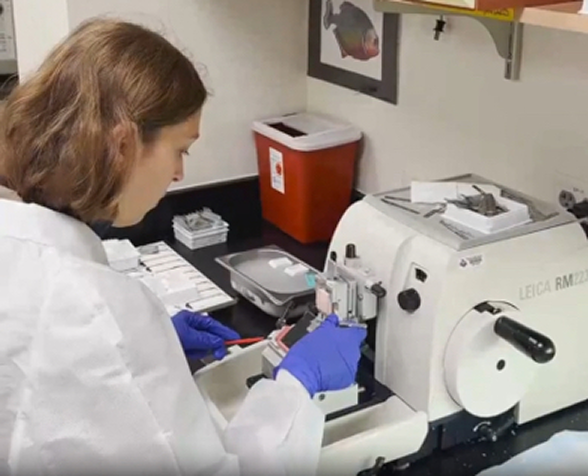
Tissue preparation is the foundation of every histology workflow. From initial processing through staining and digital analysis, the quality of the tissue section directly influences the accuracy, reproducibility, and interpretability of downstream analysis.
At HistoSpring, precision tissue processing and quality control are built into every workflow. From fixation through sectioning, each step is carefully controlled to preserve tissue integrity and support accurate, reproducible data.
Speak with our team of histology experts and let us help turn your tissue into discovery-ready data, 413-794-0523.
References
- Sisó S, Kavirayani AM, Coutoet S, et al Trends and Challenges of the Modern Pathology Laboratory for Biopharmaceutical Research Excellence. Toxicologic Pathology. 2024;12. https://journals.sagepub.com/doi/full/10.1177/01926233241303898
- Lara H, Li Z, Abels E, et al. Quantitative Image Analysis for Tissue Biomarker Use: A White Paper from the Digital Pathology Association. Applied Immunohistochemistry & Molecular Morphology. 2021;29(7). https://pmc.ncbi.nlm.nih.gov/articles/PMC8354563
- Shah M, Polónia A, Curado M, et al. Impact of Tissue Thickness on Computational Quantification of Features in Whole Slide Images for Diagnostic Pathology. Endocrine Pathology. 2025;36(1):26. PMCID: PMC11978545
https://doi.org/10.1007/s12022-025-09855-2 - Irmakci I, Nateghi R, Zhou R, et al. Tissue Contamination Challenges the Credibility of Machine Learning Models in Real World Digital Pathology. Modern Pathology. 2024;37(3):100422. doi: 10.1016/j.modpat.2024.100422
#Histology #DigitalPathology #SpatialBiology #BiomarkerResearch