
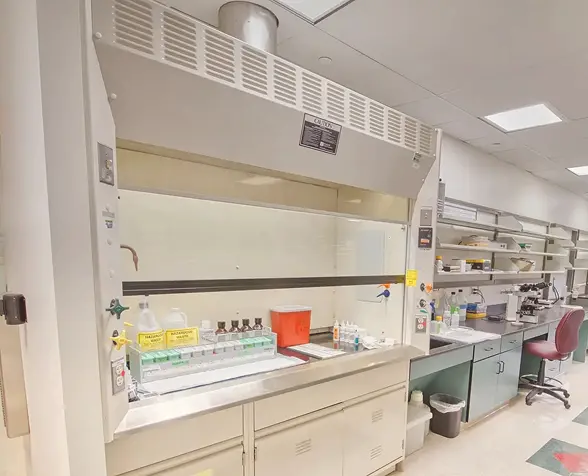
Launching or scaling work in the lab requires more than access to space, it requires an environment that is fully prepared for immediate, reliable scientific activity. While many facilities offer bench space and equipment, not all are truly ready to support active work from day one.
A research-ready wet lab is defined not just by what it contains, but by how it operates. Infrastructure, equipment, safety systems, and operational support must already be in place and functioning together. When these elements are aligned, teams can focus on scientific progress rather than setup, troubleshooting, or managing operational gaps.
What defines that level of readiness?
Core Infrastructure, Engineering, and Systems
Core infrastructure is foundational to lab performance. Ventilation, utilities, and environmental controls must work together to maintain stable conditions for day-to-day operations. HVAC systems, in particular, regulate temperature, humidity, and air pressure—factors that directly influence experimental stability.
Designing and implementing this infrastructure is complex and requires careful planning, validation, and coordination across multiple systems. When these elements are not properly designed or fully operational, even minor deviations can introduce contamination risk, disrupt lab activities, and compromise results.
A research-ready lab eliminates these challenges by ensuring that core infrastructure and environmental systems are fully operational from the start, allowing teams to begin work immediately under controlled conditions.
Consistency, Safety, and Control
Working with biological materials and chemicals requires strict protocols for handling, storage, and waste management. These practices are fundamental to maintaining a safe, controlled lab environment. Well-defined SOPs and safe handling procedures also improve efficiency by minimizing contamination, preventing accidents, and reducing downtime.
Establishing this level of consistency requires development, training, and validation. When these processes are already in place, variability is reduced from the outset. In a research-ready lab, safety and consistency are embedded in daily operations, enabling work to be performed reliably from day one.
Equipment, Operations, and Data Reliability
Even in well-resourced labs, operational and equipment challenges persist. Nearly 60% of lab professionals report significant downtime due to equipment failures, missed calibration schedules, and difficulty locating critical assets.¹ These challenges highlight that without proper maintenance, calibration, and asset management, equipment can become a source of disruption rather than productivity.
As lab complexity increases, maintenance is often deprioritized. Structured equipment management goes beyond basic upkeep by controlling costs, sustaining productivity, supporting compliance, and protecting data integrity. Without it, lapses in calibration increase risk and can compromise results. In an all-inclusive wet lab environment, equipment maintenance, calibration, and service are handled as part of the lab infrastructure, keeping instruments ready for use, reducing downtime, and supporting more consistent, reliable results.
Environment and Location
Fully serviced, turnkey wet lab environments provide a plug-and-play setting where infrastructure, safety compliance, and essential equipment are managed as part of the facility. This allows teams to focus on scientific work without the burden of capital investment, lab setup, or ongoing operational maintenance.
When a lab is prepared for active work, teams avoid delays, variability, and operational burden, allowing scientists to focus on generating data and advancing experiments. This supports efficiency and more consistent outcomes. A well-designed lab environment also provides flexibility to scale as needs evolve. As teams grow or requirements change, the ability to adapt within the same environment helps maintain continuity and avoid disruptions.
Location also plays an important role. Leading life science hubs like Boston attract scientific talent and enable collaboration across universities, research institutions, and biotech companies.² These ecosystems provide access to expertise and resources that support more connected and collaborative work.
At HistoSpring’s facility within the Baystate Research ecosystem, teams benefit from a fully supported, research-ready environment built for immediate work. Combined with access to top talent and a growing life science network in the Boston area, HistoSpring helps teams move forward with confidence from day one.
Start your work in an environment built for immediate, reliable results.
Contact us at info@histospring.com or 413-794-0523.
Footnotes
- MachineQ (Comcast Company). The State of Lab Operations: Overcoming Downtime, Inefficiencies, and Technology Gaps, 2025.
- Cushman & Wakefield. Life Sciences Update, 2026 — analysis of U.S. life science clusters, talent concentration, and market activity.
#WetLab #LabSpace #BiotechStartups #LifeScience